
Fit, Safety & Standards — Construction
Race Suit Seams and Stitching: Why the Hidden Details Matter
EN 17092 includes a real, defined seam strength test as part of full certification. A suit's leather can be excellent and its armour correctly placed, but a failed seam under load is still a failed suit. This guide covers what the certification test actually involves, why multiple rows of stitching genuinely matter, and what to check on construction quality beyond the leather itself.
By NFmoto Technical Team · Last updated 26 July 2026 · 3 min read
Seams and stitching don't get anywhere near the attention leather quality or armour placement receive, but they're tested formally as part of genuine CE certification, and for good reason: the strongest leather in the world is only as protective as the seam holding two panels together.
Seam Strength Is Genuinely Tested Under EN 17092
EN 17092 includes a specific, defined seam strength test as part of full garment certification, distinct from the abrasion and tear tests applied to the leather itself. Seam samples are tested to a formal method, with sample quantities and dimensions varying by the garment's class. For two-piece suits specifically that connect via a zip to form a single protective unit, the standard applies its own dedicated test: the connecting zip is engaged and a defined 100 Newton force is applied for 60 seconds, with a visual check afterward confirming no gapping or connection failure has occurred. This is a genuine, formal part of the certification process, not an assumption that "the zip probably holds."
A two-piece suit's connecting zip is tested under a defined 100N force for 60 seconds — a genuine, formal part of certification, not an assumption it "probably holds."
Why Multiple Rows of Stitching Genuinely Matter
Reinforced seams, using multiple parallel rows of stitching rather than a single line, are common on race suits at genuine impact zones for straightforward mechanical reasons: if one row of stitching is compromised in a slide, the others can still hold the panels together. This is basic redundancy logic, the same principle behind having more than one bolt holding a structural component, rather than a specific manufacturer marketing claim. It's worth being sceptical of any oddly specific percentage figure attached to stitching claims without a stated, checkable source. The underlying engineering logic for multiple stitch rows is sound and doesn't need an invented statistic to justify it.
Thread Matters as Much as Stitch Count
Beyond how many rows of stitching are used, the thread itself matters. High-tenacity synthetic threads (commonly bonded nylon or polyester) are standard on genuine race suits specifically because they resist the heat generated by friction in a slide better than natural fibre threads, which can weaken or melt under that kind of frictional heat. A suit that looks well-stitched from the outside but uses a lower-grade thread underneath is a real, if less visible, quality difference. It's one more reason a genuine CE certification, which tests the actual assembled garment rather than individual components in isolation, matters more than visual inspection alone.
Natural fibre thread can weaken or melt under slide friction heat. High-tenacity bonded nylon or polyester is standard on genuine race suits for exactly that reason.
A Practical Checklist Beyond Just Looking at Leather
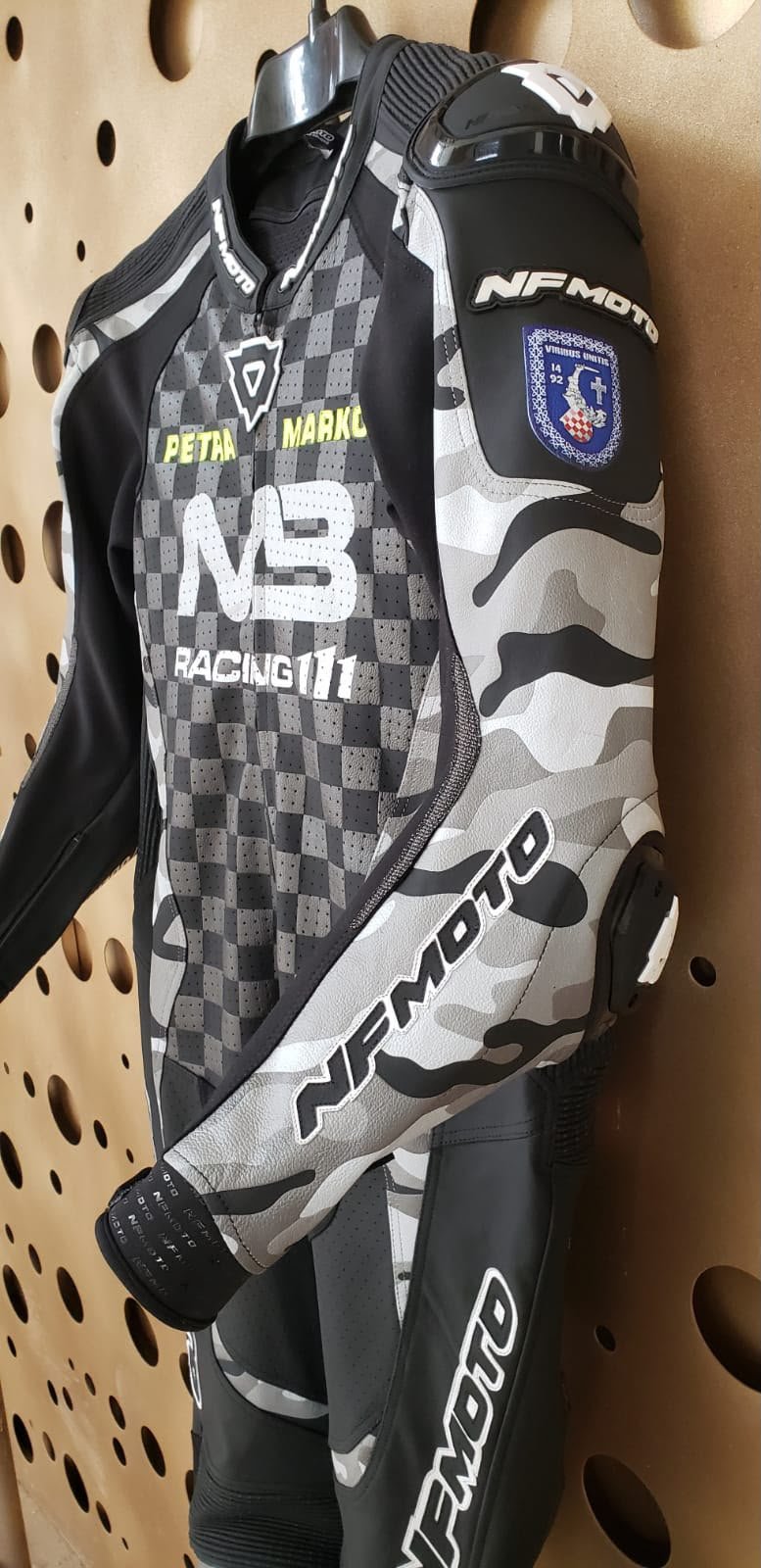
When assessing a suit's construction quality, a few checks go beyond simply looking at the leather itself. Check for consistent, even stitch spacing along a seam. Noticeably irregular spacing can indicate inconsistent machine tension or lower-quality assembly. Check that reinforced zones (multiple stitch rows) are actually present at the genuine high-risk impact areas, not just decoratively applied somewhere visible. And ultimately, checking for an actual, genuine CE certificate (which tests the assembled garment as a whole, seams included, not just the leather in isolation) remains the single most reliable way to confirm construction quality holds up to a recognised standard, rather than relying on visual inspection of stitching alone.
Where Seam Placement Matters Most
Check seam risk by body zone
EN 17092 defines risk zones across the garment (broadly, high-risk areas most likely to contact the ground in a typical slide, down to lower-risk areas), and seam construction quality matters most in exactly those higher-risk zones: shoulders, elbows, hips, and the outer leg. A seam running directly through one of these zones, positioned so it's likely to bear direct load and friction in a typical slide, is a more significant construction consideration than a seam in a genuinely low-risk area like the inner arm or torso.
This is exactly the kind of detail that separates a genuinely well-engineered suit from one that only looks similar on the surface: panel layout and seam routing designed with these risk zones in mind, rather than simply following the most visually appealing panel shapes.
Common Questions
Is seam strength actually part of CE certification?
Why do race suits use multiple rows of stitching?
Does the type of thread used actually matter?
Does seam placement matter, or just seam strength?
Can I tell seam quality just by looking at a suit?
What construction does NFmoto use for seams?
Continue Reading
Want to Check Real Certificates?
View and download NFmoto's actual CE certification documents before you order.